CNC probe stylus selection starts with the surface you need to reach, not the longest stem or smallest ball in a catalog. Within a probe system's approved configurations, aim for the shortest practical arrangement that reaches the reference without interference. The ball must fit the feature, the stem must clear the surrounding material, and the probe body must have room to follow the planned approach.
Those requirements can pull in different directions. A small ball may enter a narrow opening but leave little space between the stem and a nearby wall. A longer stylus may reach farther below the body while introducing more flexibility. Understanding which restriction matters lets you evaluate a setup instead of treating either change as an automatic upgrade.
Start at the Intended Contact, Then Look Outward
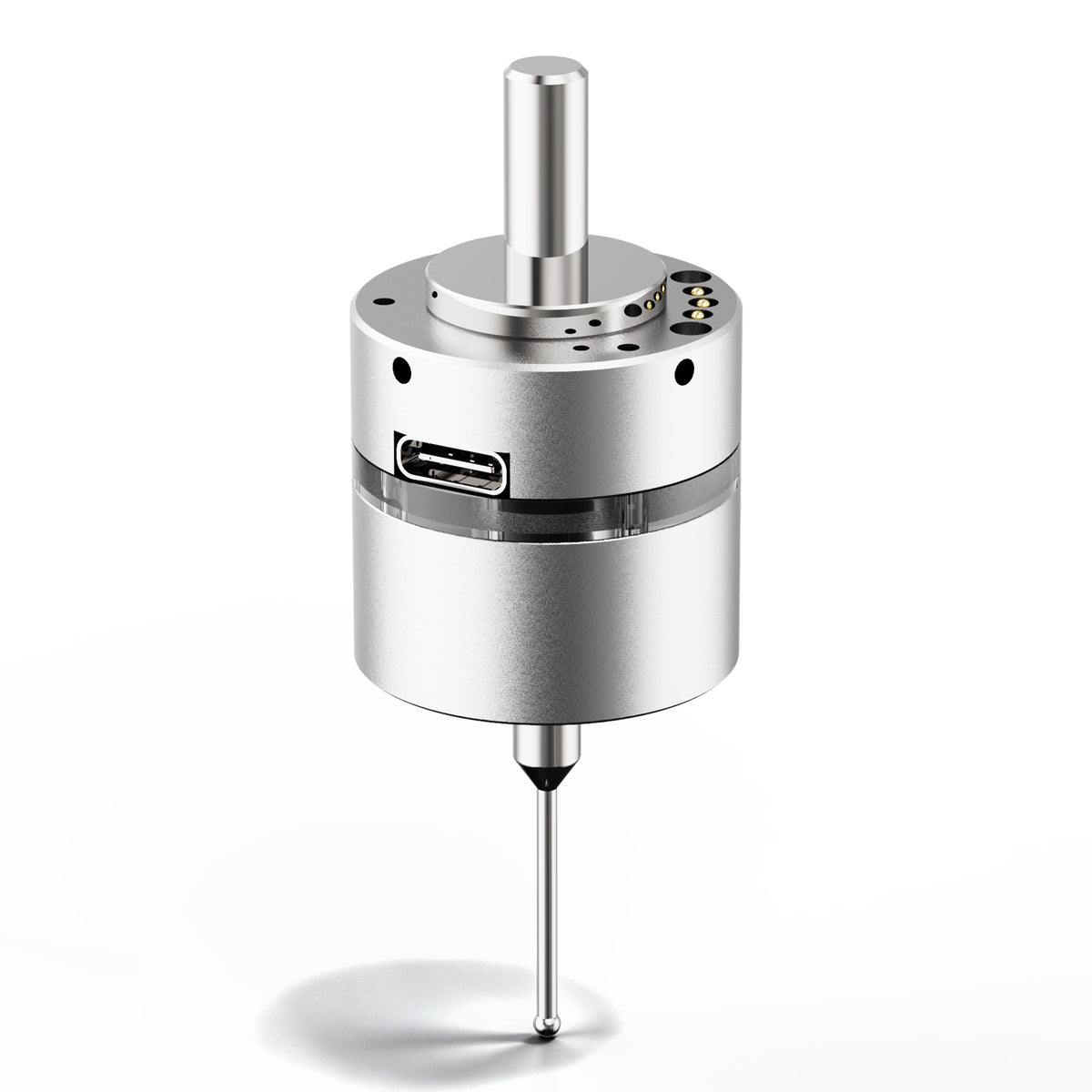
The stylus is the contact element attached to the probe. In a straight, ball-ended arrangement, the ball touches the reference and the stem connects it to the probe. The larger probe body and its mounting are separate parts of the assembly. Keeping those parts distinct matters: enough room for a ball does not necessarily mean enough room for the rest of the hardware.
Imagine an open outside face on a securely held blank. There may be ample space beside that face, so reaching it does not require the stylus to descend into a cavity. Now imagine a reference wall down inside a recess. The ball needs an entry route, the stem needs space beside the wall, and the body must remain clear of the upper surface and workholding. Both references might belong to the same part, yet impose very different access requirements.
This is a hypothetical geometry comparison, not an ED1 setup or a claim that either feature is accessible with its supplied probe. Its purpose is to separate the obstacles. If the body reaches an obstruction before the ball reaches the reference, extra clearance around the ball alone will not solve the problem. If the ball cannot enter the opening, extra length alone will not solve that problem either.
Overall Length and Effective Working Length Answer Different Questions
A long stylus can look capable of reaching a deep feature, but nominal length does not describe every contact it can make. Renishaw's touch-trigger probe applications guide defines effective working length, or EWL, in terms of penetration before the stem interferes with the feature. That is a different question from how far the assembly extends from its mounting.
For a simple spatial illustration, consider a straight stylus approaching a vertical wall. At ball contact, the ball's side extends farther toward the wall than the side of a narrower stem. That difference provides space between the stem and wall. If the stem widens higher up, or surrounding material projects into that space, useful penetration can end before the full stylus length has been used. This explanation assumes the illustrated straight-wall relationship; it is not a clearance calculation for a particular probe.
Return to the hypothetical recess. If the ball reaches the wall near the opening but the stem would rub as it travels deeper, the restriction concerns useful penetration. A configuration with a longer overall dimension does not automatically change the interfering relationship. You need the documented geometry of the complete approved arrangement, not an estimate made from a product photograph.
EWL is therefore useful information, but it is not a blanket collision guarantee. A value describing stem clearance at a feature does not establish room for the probe body, a nearby clamp or the movement needed to withdraw. Read the dimension's definition and application conditions rather than treating every length on a drawing as interchangeable reach.
A Larger Ball Can Help Clearance—and Prevent Entry
Renishaw recommends a ball as large as the application allows in its CMM guidance, explaining the relationship to ball-to-stem clearance. The qualifying phrase matters. Holding the stem geometry constant, a larger ball extends farther beyond the stem, which can help the ball contact a wall while keeping the stem away from it. It does not follow that the largest available ball is suitable for every feature.
A narrow opening imposes the opposite constraint: the ball has to pass through it. A ball that cannot enter cannot locate a reference beyond it, regardless of the available stem length. Even after entry, the intended wall must be accessible without another surface blocking the approach. Being somewhere inside the cavity is not the same as reaching the chosen contact.
Shrinking the ball can solve an entry restriction while reducing the clearance around a given stem. That tradeoff explains why a visually smaller tip is not automatically a more capable probe. Compare the actual ball-and-stem combination, the target surface and the route to it together. Do not infer a universal minimum opening or maximum recess depth from the word “3D” in a probe name.
The outside-face example has fewer surrounding restrictions than the recess example. If the intended machining reference can legitimately be established from an accessible outside feature through the supported workflow, that may avoid a difficult internal approach. Changing the reference still requires agreement with the design and work-coordinate method; it is not permission to touch an arbitrary convenient surface and assume the same result.
Use Only the Reach the Supported Task Requires
Both Renishaw and Hexagon advise using the shortest practical stylus for their documented CMM applications. Their reason is bending and deflection: added reach is not free of mechanical consequences. They also favor minimizing unnecessary joints or extensions. This is qualitative selection guidance, not a numerical prediction of an ED1 probe's error.
“Shortest practical” does not mean choosing a stylus that falls short of the reference. It means satisfying the access requirement without adding reach that the job does not need. In the open-face example, extending farther below the probe body might offer no access benefit. In the recessed example, some additional reach could be necessary, but it would still have to resolve the actual obstruction within an approved configuration.
Hexagon also identifies permissible total stylus-configuration weight as sensor-dependent. A configuration is consequently more than a matching thread or an attractive overall length. Supported components, loading and the system's qualification requirements belong to the selection. After an approved configuration change, follow that system's required qualification and performance checks rather than assuming the previous setup remains valid.
These sources concern CMM equipment. Their general tradeoffs help explain the selection problem, but their component combinations, limits and adjustment instructions are not operating instructions for another probe. Do not improvise an extension or alter trigger force to make an unsupported arrangement appear usable.
Applying the Access Question to the ED1 Wired Probe
The TwoTrees ED1 3D wired probe is the dedicated workpiece-origin positioning accessory for the ED1 desktop CNC router. That role is useful when a prepared design needs a physical reference on secured stock. Access planning asks whether the intended reference can be reached in the documented setup; it does not turn the accessory into a universal feature-inspection system.
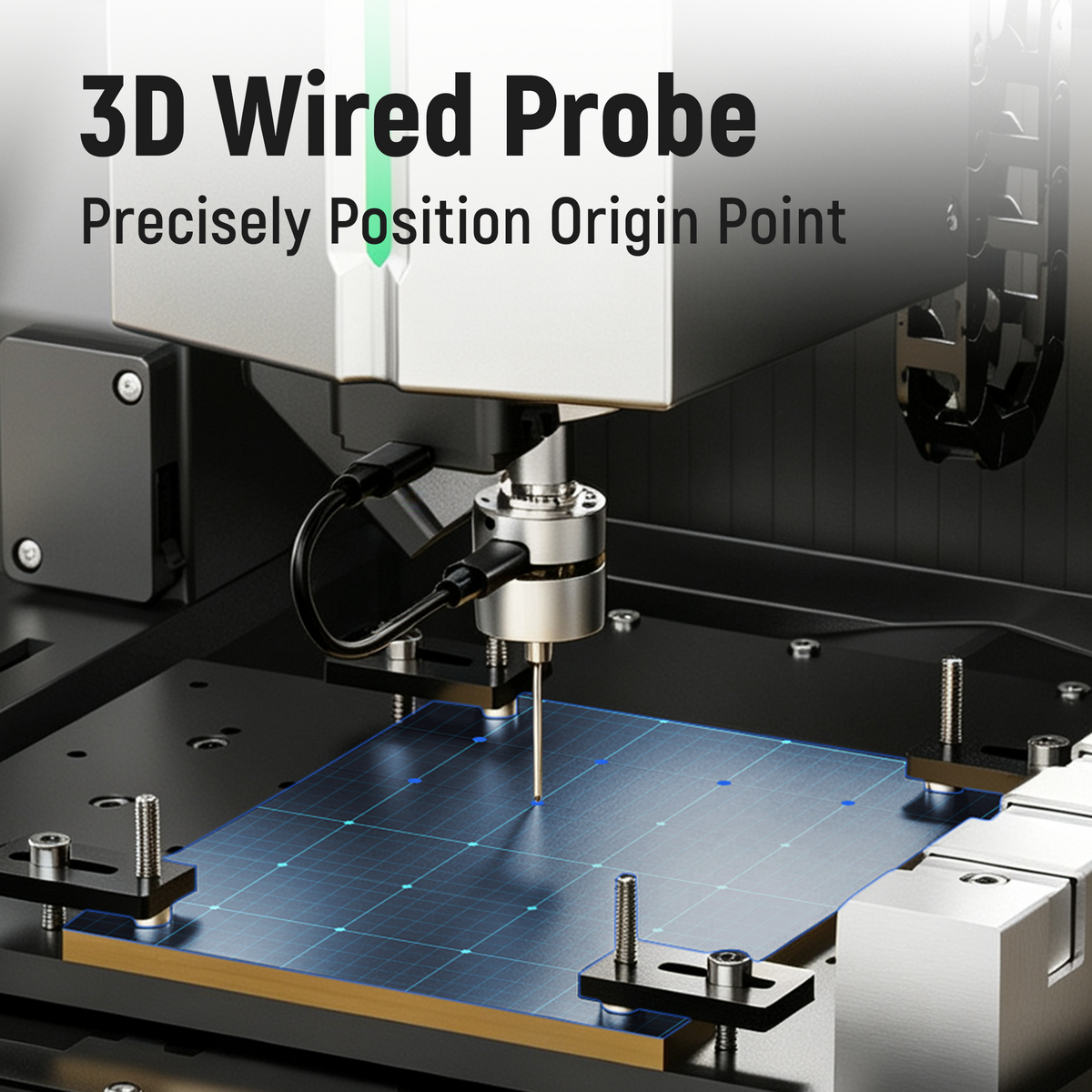
For a supplied desktop probe, the immediate decision may be whether the project suits its approved arrangement, rather than which replacement stylus to buy. Do not assume that the ED1 stylus is interchangeable or that a third-party ball, stem or extension is compatible. A photograph can identify the visible hardware, but cannot approve an alternate assembly or establish the reach of a particular setup.
Before physical adjustments, keep the spindle stopped, secure the stock and follow the exact manufacturer's safe-isolation and setup procedures. Consider the route to the contact and the route away from it, including clamps and the probe body—not just a clear-looking final position. A reference that can be reached only by putting another part of the assembly into an obstruction is not a usable reference for that approach.
The decision is complete when the chosen physical reference, approved probe arrangement and supported positioning method agree. If the reference cannot be reached that way, reconsider the reference or workholding through the approved workflow. Adding length or reducing ball size without resolving the actual restriction merely changes the hardware question; it does not resolve access.